Showing posts with label Most Endangered Species. Show all posts

Monday, September 3, 2012

Most Endangered Species - Bluefin Tuna

Most Endangered Species - Bluefin Tuna 

The Atlantic bluefin tuna (Thunnus thynnus) is a large migratory fish found in the western and eastern Atlantic and the Mediterranean Sea. Bluefin tuna is the source of highest grade sushi. Bluefin tuna fisheries are near collapse and the species at serious risk of extinction if unsustainable fishing practices in the Eastern Atlantic and Mediterranean are not stopped.

The Atlantic bluefin tuna is one of the largest, fastest, and most gorgeously colored of all the world’s fishes. Their torpedo-shaped, streamlined bodies are built for speed and endurance. Their coloring—metallic blue on top and shimmering silver-white on the bottom—helps camouflage them from above and below. And their voracious appetite and varied diet pushes their average size to a whopping 6.5 feet (2 meters) in length and 550 pounds (250 kilograms), although much larger specimens are not uncommon. A temporary ban on the global trade of bluefin tuna would allow the overexploited species to recover.

WWF is encouraging restaurants, chefs, retailers, and consumers to stop serving, buying, selling, and eating endangered bluefin tuna until this amazing species shows signs of recovery. Atlantic bluefins are warm-blooded, a rare trait among fish, and are comfortable in the cold waters off Newfoundland and Iceland, as well as the tropical waters of the Gulf of Mexico and the Mediterranean Sea, where they go each year to spawn. They are among the most ambitiously migratory of all fish, and some tagged specimens have been tracked swimming from North American to European waters several times a year.

Bluefin tuna have been eaten by humans for centuries. However, in the 1970s, demand and prices for large bluefins soared worldwide, particularly in Japan, and commercial fishing operations found new ways to find and catch these sleek giants. As a result, bluefin stocks, especially of large, breeding-age fish, have plummeted, and international conservation efforts have led to curbs on commercial takes. Nevertheless, at least one group says illegal fishing in Europe has pushed the Atlantic bluefin populations there to the brink of extinction. 

Bluefin Tuna - Most Endangered Species 
  
The Atlantic bluefin tuna - Thunnus thynnus

Most Endangered Species - Magellanic Penguin

Magellanic Penguin Habitat (Spheniscus magellanicus)

Magellanic Penguins are found around the coast line of Chile, Argentina and the Falkland Islands. They spend their time at sea and when they come ashore to breed they form large colonies.

Once threatened primarily by oil spills, Magellanic penguins (Spheniscus magellanicus), now face a larger threat as fish are displaced by warming ocean currents, forcing the birds to swim farther to find food. Last year hundreds of Magellanic penguins washed up on beaches around Rio de Janeiro, many emaciated or dead.

Scientists have speculated that changes in ocean currents or temperatures, which may be related to climate change, could have been responsible for their movement more than a thousand miles north of their traditional nesting area in the southern tip of Argentina. Twelve out of the 17 penguin species are currently experiencing rapid population decline

Most Endangered Species - Magellanic Penguin 

Magellanic Penguin Breeding

Magellanic Penguins breed between September and February and they gather in large nesting colonies. They pair up for life and they construct their nests under bushes or in burrows. Two eggs are laid and they are incubated for 39 - 42 days. Both parents incubate the eggs taking it in turns for 10 - 15 days shifts. Upon hatching the chicks are cared for by both parents for one month and they are fed every 2 - 3 days.

They gain their adult plumage when they are approximately one month old and at 60 - 70 days old they are ready to head out to sea. Magellanic Penguins become sexually mature between 2 and 3 years of age.

Magellanic Penguin

Magellanic Penguin Predators

Predators of adult Magellanic Penguins include sea lions and their chicks are preyed upon by kelp gulls and the giant petrel.
Magellanic Penguin - Most Endangered Species

Magellanic Penguin Main Characteristics.

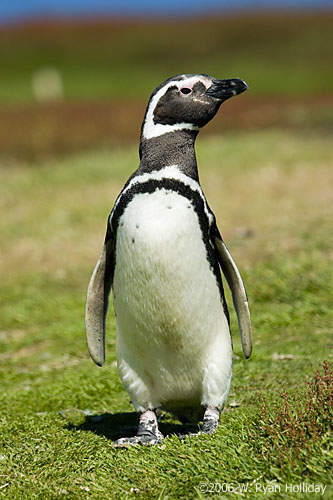
Magellanic Penguins are between 70 and 76 cms (28 - 30 inches) in height and they weigh between 4 and 6 kgs (8.8 and 13 lbs). They are coloured black/dark grey on their back and white on their front. They have a distinctive, black, horseshoe shaped band on their front and a thick black band that runs under their chin.

Their tail is short and wedge shaped and they have long, narrow wings that they use like paddles when swimming. They are excellent swimmers and can swim at speeds over 24 km/hr (15 mph).

During periods of warmer weather Magellanic Penguins lose their feathers around their eyes. As the weather becomes colder, their feathers grow back once again.